
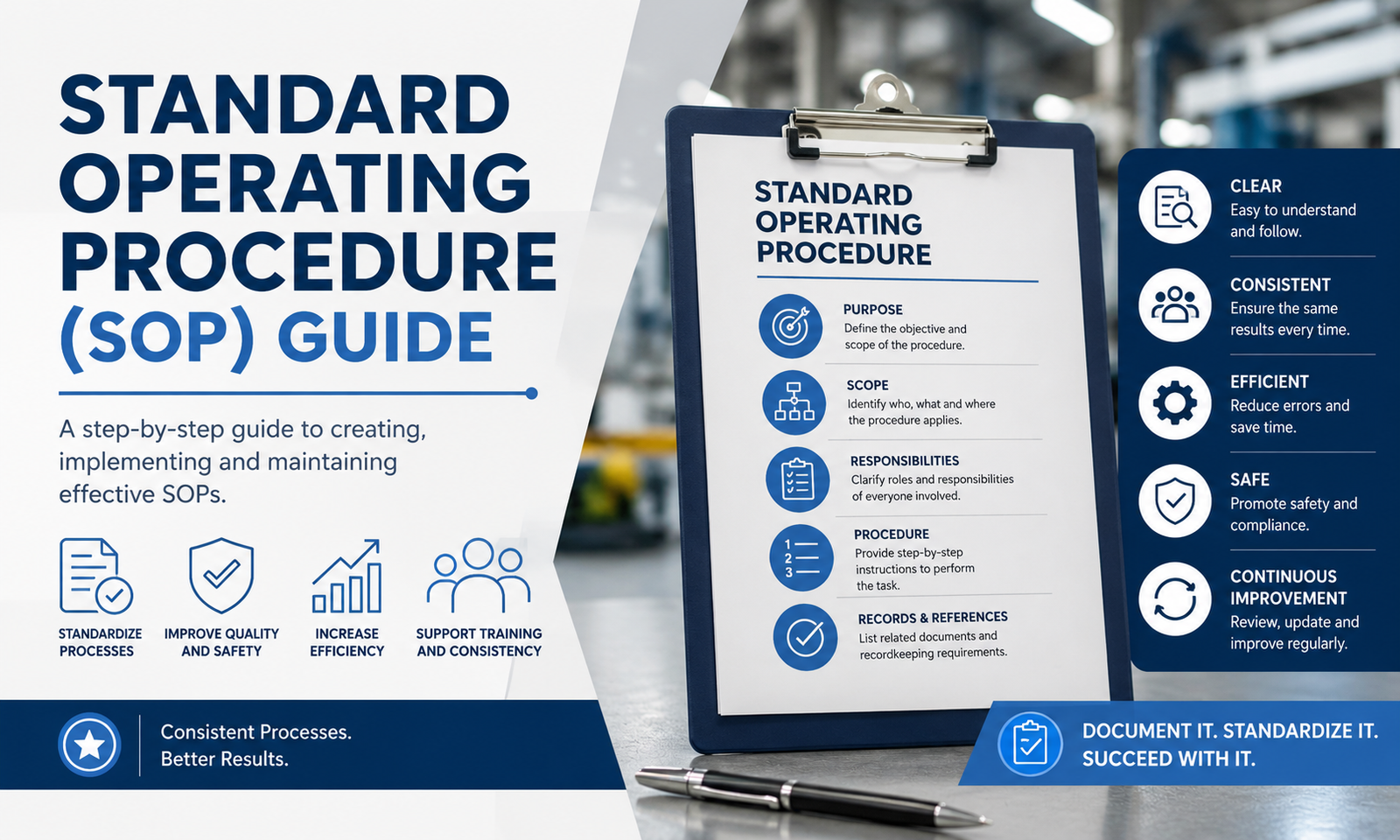
Table of Contents
- What Is Protocolo Operacional Padrao?
- Why Your Business Needs It Now
- 7 Effective Strategies for Implementation
- Common Mistakes to Avoid
- Quick Insights: Real-World Impact
- FAQs
- Conclusion
Most businesses fail not because of bad ideas — but because of inconsistent execution.
One day your team delivers exceptional results. The next, the same process produces errors, delays, and frustrated customers. Sound familiar?
That’s exactly why Protocolo Operacional Padrao (POP) exists. Translated from Portuguese, it means Standard Operating Protocol — and it’s one of the most powerful tools for creating predictable, scalable, and efficient operations.
Whether you run a small startup or a growing enterprise, implementing a Protocolo Operacional Padrao can be the difference between a business that struggles to scale and one that runs like clockwork.
In this guide, you’ll discover 7 proven strategies to implement it effectively — starting today.
What Is Protocolo Operacional Padrao?
Protocolo Operacional Padrao is a documented set of step-by-step instructions that guides employees through recurring tasks and processes.
Think of it as your business’s playbook — a clear, repeatable framework that ensures every team member performs tasks the same way, every single time.
Featured Snippet Answer: A Protocolo Operacional Padrao (POP) is a standardized document that outlines the exact steps employees must follow to complete specific tasks. It reduces human error, ensures consistency, maintains quality control, and enables faster onboarding — making it essential for any business aiming to scale efficiently.
Why Your Business Needs It Now
Operational chaos is expensive. Research consistently shows that poorly documented processes lead to:
- Up to 20–30% productivity loss due to repeated mistakes
- Higher employee turnover from unclear expectations
- Customer dissatisfaction caused by inconsistent service delivery
- Slower onboarding for new hires
A well-implemented Protocolo Operacional Padrao supports better data-driven decision making by ensuring every team operates from accurate, consistent information.
7 Effective Strategies for Implementing Protocolo Operacional Padrao
Strategy 1: Start With Your Most Critical Processes
Don’t try to document everything at once. Instead, identify the 3–5 processes that most directly impact your revenue, customer satisfaction, or operational efficiency.
Start there. Build momentum. Then expand.
Pro tip: Ask your team: “What tasks cause the most confusion or errors?” Their answers will point you directly to your highest-priority POPs.
Strategy 2: Involve Your Front-Line Team in the Writing Process
Here’s a mistake many managers make — they write the POP themselves, from the top down.
The problem? The people actually doing the work know the nuances, shortcuts, and common failure points far better than leadership does.
Involve them. Hold working sessions. Let them co-author the protocols. This also dramatically improves buy-in and adoption.
Strategy 3: Use a Clear, Consistent POP Template
Every Protocolo Operacional Padrao document should follow the same structure. This makes it easier to read, update, and train with.
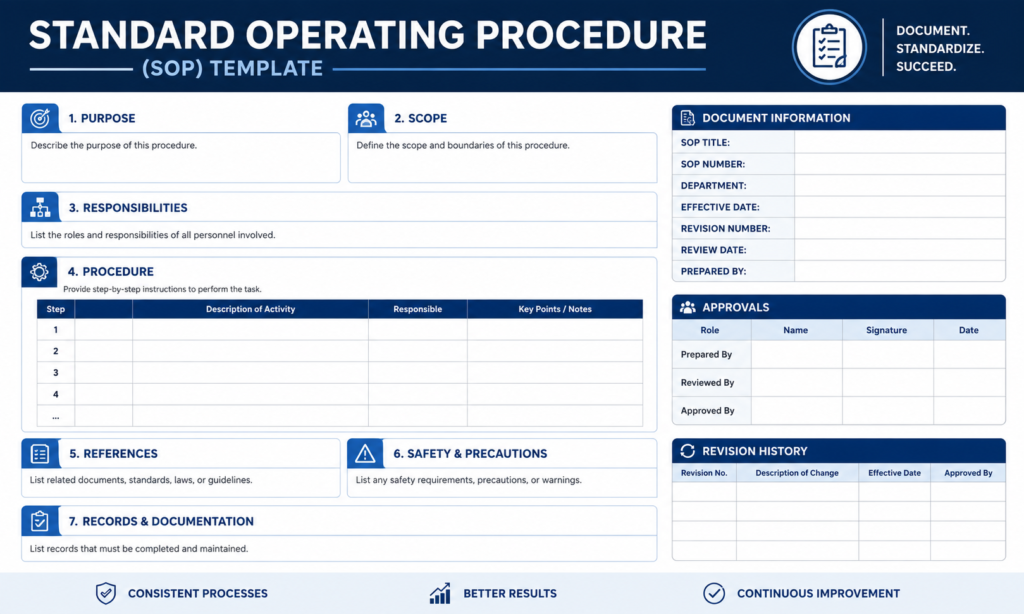
A strong POP template includes:
- Process title and unique ID code
- Objective and scope
- Responsible team or role
- Materials/tools required
- Step-by-step instructions (numbered)
- Quality checkpoints
- Revision history and approval signature
Consistency in format is just as important as consistency in execution.
Strategy 4: Use Visuals, Videos, and Flowcharts
Text-heavy documents are hard to follow, especially during fast-paced operations. Therefore, enrich your POPs with visual support.
Effective visual formats include:
- Decision flowcharts for complex branching processes
- Short screen-recorded videos for software workflows
- Annotated photos for physical or equipment-based tasks
- Checklists for quality control steps
Visual POPs reduce training time and dramatically improve accuracy.
Strategy 5: Store and Distribute POPs Digitally
Paper binders are a thing of the past. However, many businesses still rely on them.
Use a centralized digital platform so your team can access the right protocol at any time, from any device. Good options include:
- Notion — flexible and team-friendly
- Google Drive — simple and familiar
- Confluence — powerful for larger organizations
- Trainual — purpose-built for SOPs and onboarding
Make searchability a priority. If your team can’t find the right POP in under 30 seconds, it won’t get used.
Strategy 6: Build a Review and Update Schedule
A POP that isn’t regularly reviewed becomes outdated — and an outdated protocol can be worse than no protocol at all.
Best practice: Review each POP every 6 months, or immediately after:
- A significant process change
- A recurring error is identified
- New tools or technology are introduced
Assign a process owner for each POP. That person is responsible for keeping it current and accurate.
Strategy 7: Train, Audit, and Reinforce
Writing a Protocolo Operacional Padrao is only half the work. Implementation is where most businesses fall short.
Build a training plan around each new POP. Then audit compliance regularly — not to punish, but to identify gaps and improve.
Reinforcement tactics that work:
- Include POP review in onboarding checklists
- Add protocol adherence to performance reviews
- Celebrate teams that follow and improve existing POPs
Culture eats documentation for breakfast. Build a culture that values consistency.
Common Mistakes to Avoid
Even well-intentioned POP programs can fail. Watch out for these pitfalls:
- Making protocols too long or complex — if it takes 20 minutes to read, it won’t be followed
- Writing in jargon — use plain, simple language your entire team understands
- Ignoring feedback — if employees flag issues, update the document promptly
- Creating POPs without ownership — every protocol needs a named owner
Quick Insights: Real-World Impact
Businesses that implement structured standard operating procedures report:
- 50% faster employee onboarding
- 35% reduction in operational errors
- Significant improvement in customer satisfaction scores
- Greater ability to delegate — freeing leadership to focus on growth
Pairing your POP framework with modern business data solutions gives your team both the process clarity and the real-time intelligence needed to scale confidently.
Key Takeaways
- Protocolo Operacional Padrao creates consistency, reduces errors, and enables scale
- Start with your most critical processes, not everything at once
- Involve front-line staff in writing POPs for better accuracy and adoption
- Use visual formats and digital storage for maximum accessibility
- Review and update regularly — assign clear ownership to each protocol
Conclusion
Implementing a Protocolo Operacional Padrao is one of the smartest operational decisions you can make for your business. It brings clarity to confusion, consistency to chaos, and scalability to what would otherwise remain dependent on individual memory and effort.
Start small. Pick one critical process. Document it well. Train your team on it. Then build from there.
Ready to build a business that runs on systems, not stress? Start mapping your first Protocolo Operacional Padrao today — and watch the difference it makes within 30 days.
FAQs
Q1: What does Protocolo Operacional Padrao mean in English? It translates to “Standard Operating Protocol” or Standard Operating Procedure (SOP). It is a structured document guiding employees through specific tasks in a consistent, repeatable way.
Q2: How long should a Protocolo Operacional Padrao document be? Ideally, one to two pages for simple tasks. Complex processes may require more, but clarity always matters more than length. If it’s too long, break it into sub-protocols.
Q3: Who should write a business POP? A team effort works best. A manager or process owner leads the project, but front-line staff who perform the task daily should actively contribute to ensure accuracy.
Q4: How often should POPs be updated? Review every six months at minimum, or immediately after any significant change in tools, personnel, regulation, or process outcomes.
Q5: Can small businesses benefit from Protocolo Operacional Padrao? Absolutely. In fact, small businesses benefit the most — because every person plays multiple roles, having clear protocols prevents chaos and accelerates growth.